
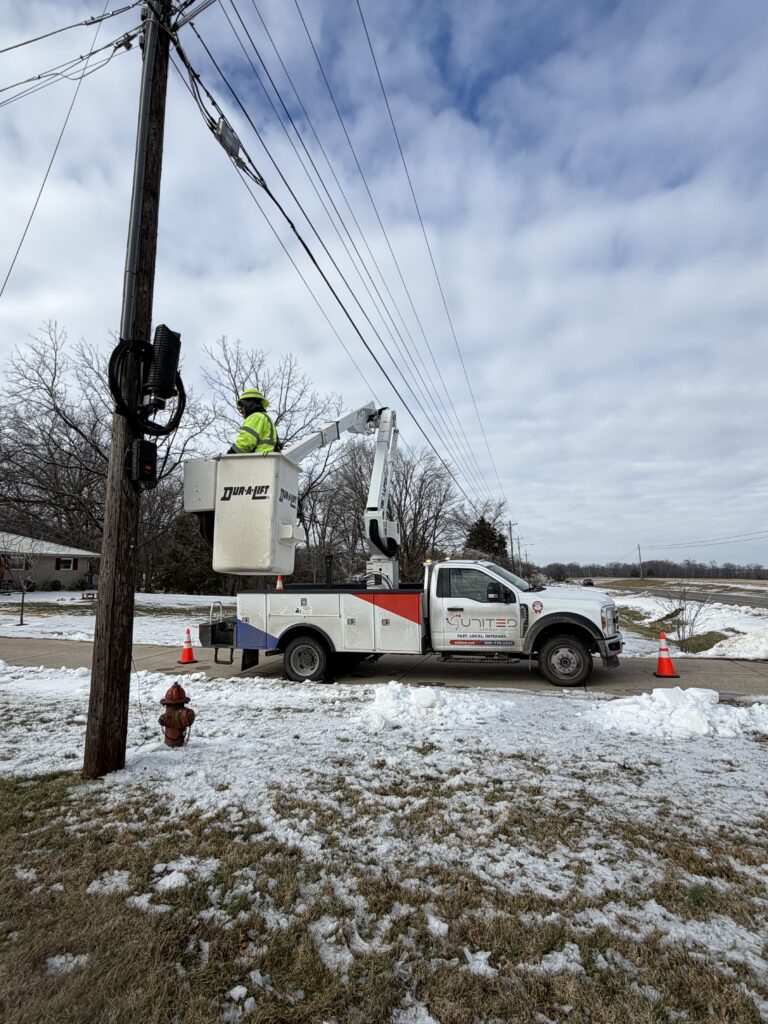
If you live in Middle Tennessee, you know the signs of severe weather. The sky turns a steely gray color before a storm hits. The milk and bread aisles are completely empty at the threat of snow or ice. Around here, the weather changes fast, and when it does, people feel it right away.
This winter has given us a powerful reminder of this! To start off 2026, Middle Tennessee experienced one of the worst ice storms in decades, and possibly the most severe since 1951. Thick sheets of ice coated the roads, trees, and power lines all across our region. Thanks to advance preparation, rapid mobilization, and a diligent, comprehensive response from our team, United experienced zero network node or core transport outages during the storm (in other words, the storm didn’t cause any major problems with our network). While I’m incredibly proud of this achievement (something few of our competitors can claim), this outcome did not happen by accident.
As Director of Engineering and Construction at United Communications, I have spent the last six years helping build our fiber internet network, and I take real pride in what it delivers for our customers. When you work from home, run a business, help your kids learn online, or check in on loved ones during a storm, your internet connection should not be another thing to worry about.
As we find ourselves in another severe weather season, I want to explain why United’s fiber network performs better than traditional cable internet, how our infrastructure made a difference during this year’s ice storm, and what you can do at home or work to stay connected when the weather turns bad.
The Fiber Difference: Why Storms Knock Internet Offline for Most Providers
Most internet outages during storms are caused by two things: power loss or physical damage.
In Middle Tennessee, these two issues can create outages at any time. Ice builds up on lines. Wind snaps branches onto poles. Utility infrastructure is overburdened, knocking out power. Any one of those events can impact internet service.
The difference is that traditional DSL or cable internet runs through networks that depend on powered equipment all along the route between a provider and a customer. Signal boosters, amplifiers, and cabinets all need electricity to function. If power drops anywhere in that chain, service goes down.
Fiber works differently. It is a passive network that does not need power along the transmission path. Only the equipment at the starting point and at the customer’s location requires electricity. That design matters a lot during storms.
With fewer powered components in the field, fiber has fewer failure points, staying online more often during widespread power outages. It handles heavy rain, ice, and wind better than older technologies.
Over the years, I’ve watched fiber routes stay live while surrounding cable networks went dark. The intentional design and construction of our network also makes a difference.
How United Built a Storm-Ready Network
At United, we built our network with Middle Tennesseans in mind. Since we’ve served this region for nearly 80 years, we know the weather, and we care about the people who depend on us to stay connected. Here are a few specific ways we’ve gone “above and beyond” standard protocols to build a storm-ready network:
1. Our network is built to function in adverse conditions
We centralize our core network equipment in hardened facilities built to withstand severe weather. These sites include battery backups and on-site generators that switch automatically when commercial power drops.
That setup keeps our core systems running during long power outages. It maintains service continuity for customers even when the grid goes down.
2. We’ve installed intentional backup routes.
Over the past decade, we have built significant redundancy into our fiber rings and distribution network. In simple terms, we create multiple paths for traffic to travel. If one route gets damaged, traffic reroutes automatically over a different path. The result? Fewer outages and faster recovery when storms cause physical damage.
3. Our infrastructure protects against pole failures.
Not all fiber runs underground. To test its capacity, we use medium ice-loading models and run pole-loading analysis for every installation. When we build, we also account for existing attachments, ice accumulation, and wind load.
Our construction team also builds our network to copper-era standards. Because fiber is lighter than copper, our poles usually operate at less than 30 percent of their rated load capacity. That gives us a large safety margin during extreme weather, leading to fewer pole failures when ice and wind hit the area.
4. We prepare before issues arise.
Our customer service team and technicians have created a storm readiness program. We monitor weather patterns and network conditions around the clock. If we notice a potential threat, we stage crews in advance and pre-position equipment and supplies.
This year, well before any storms hit our area, our sites were prepared with fueled generators, our vehicles were staged and ready to deploy, and all support team members were equipped to work remotely. These preparations significantly improved our ability to move quickly to high-risk areas and respond to any issues.
5. We stay committed to customers through any storm.
When severe weather strikes Middle Tennessee, preparation matters, but so does how a team responds in the moment. During storms, like the one we just experienced, our goal is simple: keep customers connected and supported as safely and quickly as possible. This means proactively monitoring major fiber routes to assess damage and identify any areas that may need repair once conditions improve.
At the same time, our local support team stays fully engaged. They answer phones, respond to critical tickets, and investigate potential customer impacts before issues escalate. That combination of field response and customer care reflects how United approaches storms: we stay calm, we stay available, and we take responsibility for our network and our neighbors—no matter what the weather brings.
How to Proactively Prepare Your Internet for Severe Weather
While our network is built to withstand severe weather, a few simple in-home safeguards can help you maintain connectivity during power-related disruptions. Here’s what I recommend to help you stay connected when the weather turns rough:
1. Protect your in-home equipment.
Your modem and router still need power to work, even if our fiber network stays up. A small battery backup can keep your connection running during short power outages. Using surge protectors helps shield your equipment from possible voltage spikes during storms. Together, these steps can help you maintain connectivity.
2. Understand what causes outages.
When commercial power goes down or a pole gets damaged, restoration can take time. In those cases, we often have to coordinate repairs with local utilities before we can safely restore service. When storms hit, we always put safety first. Once the area is secured, we work to restore service to the greatest number of customers as quickly as possible.
3. Stay informed and report any issues
During and after storms, United shares updates, restoration progress, and status messages as conditions change. Check up on outage updates regularly and report any issues you experience. Our team proactively works to address issues as quickly as possible, and your support makes all the difference.
Internet Built for Middle Tennessee Weather
Storms will always be part of life here in Middle Tennessee. While we can’t prevent wind, ice, or power outages, we have built a network that holds up well when those moments arrive.
By designing our fiber network to reduce failure points and remain operational during power disruptions, we can recover more quickly when damage happens. When the next storm hits Middle Tennessee, we will be ready to help you stay connected and prepared for what’s next.
########
Author Bio:

Tim Thompson
Director of Engineering & Construction
Tim Thompson is a seasoned telecommunications professional with a distinguished career spanning various roles across operations, engineering, and construction. Driven by a passion for connecting communities and supporting suburban and rural areas, Tim joined United Communications in 2019. In his current role as director of engineering and construction, he oversees the team responsible for expanding, deploying, and maintaining our fiber optic network. His expertise and leadership play a pivotal role in Project UNITE, an initiative dedicated to providing underserved communities across Middle Tennessee with access to high-speed broadband internet.